


Key Takeaways
-
Brepocitinib met the primary endpoints in both Phase 3 CLARITY trials involving 371 patients with noninfectious uveitis
-
Significant benefits were reported in steroid-free quiescence, retinal vascular leakage, macular edema, and visual functioning
-
No new safety signals were identified, and Priovant plans an FDA submission in the first half of 2027
Roivant and Priovant Therapeutics announced positive topline results from the Phase 3 CLARITY program evaluating brepocitinib in patients with noninfectious uveitis (NIU), reporting that both CLARITY-1 and CLARITY-2 met their primary endpoints.
Brepocitinib also demonstrated statistically significant and clinically meaningful improvements across all key secondary endpoints, including sustained steroid-free quiescence at Week 48, chorioretinal vascular leakage, macular edema resolution, and patient-reported visual functioning.
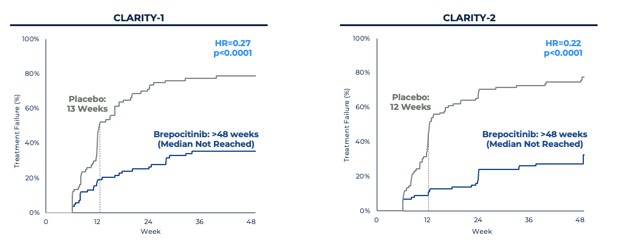
The CLARITY program enrolled 371 patients across 2 identically designed studies. Participants were randomized 1:1 to receive once-daily brepocitinib 45 mg or placebo during a 48-week double-masked treatment period.
All participants received oral prednisone at 60 mg/day for 2 weeks, followed by a mandatory 6-week taper to zero. The primary endpoint was time to treatment failure, assessed from Week 6 through Week 48.
Time to treatment failure in CLARITY-1 and CLARITY-2 (Kaplan-Meier estimates, brepocitinib vs. placebo) is captured below:
According to the companies, brepocitinib demonstrated consistent benefits across patients with intermediate, posterior, and panuveitis; those with and without previous tumor necrosis factor inhibitor exposure; and multiple disease etiologies, including birdshot chorioretinopathy and sarcoidosis.
“These results from the Phase 3 CLARITY program suggest that brepocitinib could meaningfully change how we treat non-infectious uveitis across multiple etiologies,” said Quan Dong Nguyen, MD, MSc, professor of ophthalmology at Stanford University School of Medicine.
Brepocitinib was generally well tolerated, with most adverse events classified as mild or moderate. Treatment discontinuation due to adverse events occurred in 3% of participants, and no new safety signals were identified.
Priovant plans to submit a supplemental new frug application to the FDA for brepocitinib in NIU during the first half of 2027.
The companies did not provide numerical efficacy results or detailed statistical analyses in the supplied announcement.
