


Key Takeaways
- The FDA has accepted and filed Nanoscope Therapeutics’ BLA for Mogenry, an investigational optogenetic gene therapy for patients with RP and severe vision loss
- The application is supported by phase 1/2a and phase 2b/3 data, with RESTORE meeting its primary and key secondary endpoints and showing visual acuity improvements at weeks 52 and 76
- If approved, Mogenry could become the first gene-agnostic therapy to improve vision in patients with RP and severe vision loss, with a one-time, in-office administration approach that does not require genetic testing
The FDA has accepted and filed Nanoscope Therapeutics’ biologics license application (BLA) for Mogenry (sonpiretigene isteparvovec; MCO-010), an investigational optogenetic gene therapy designed to restore vision in patients with retinitis pigmentosa (RP) and severe vision loss.
The regulatory milestone moves the one-time therapy into FDA review. If approved, Mogenry would become the first gene-agnostic therapy to improve vision in patients with RP and severe vision loss, according to Nanoscope.
"FDA acceptance and filing of our BLA for MOGENRY is a crucial milestone that brings us a critical step closer to offering a one-time, in-office treatment option to the retinitis pigmentosa community with severe vision loss, who have no approved therapy today," said Sulagna Bhattacharya, Chief Executive Officer of Nanoscope Therapeutics. "The strength of our RESTORE data, together with the durability we have observed through long-term follow-up in the REMAIN study, give us confidence in MOGENRY's potential to become a new standard of care for patients living with RP having severe vision loss. We look forward to working closely with the FDA throughout its review."
The FDA has issued a PDUFA (Prescription Drug User Fee Act) date in the first half of 2027. Nanoscope told Eyewire News it is actively preparing to be commercial-ready in the first half of 2027.
The application is supported by efficacy and safety findings from a Phase 1/2a study (NCT04919473) and the phase 2b/3 RESTORE trial (NCT04945772). RESTORE was a multicenter, randomized, double-masked, sham-controlled clinical trial evaluating Mogenry in patients with RP and severe vision loss. According to Nanoscope, the trial met its primary and key secondary endpoints, demonstrating improvements in visual acuity at weeks 52 and 76.
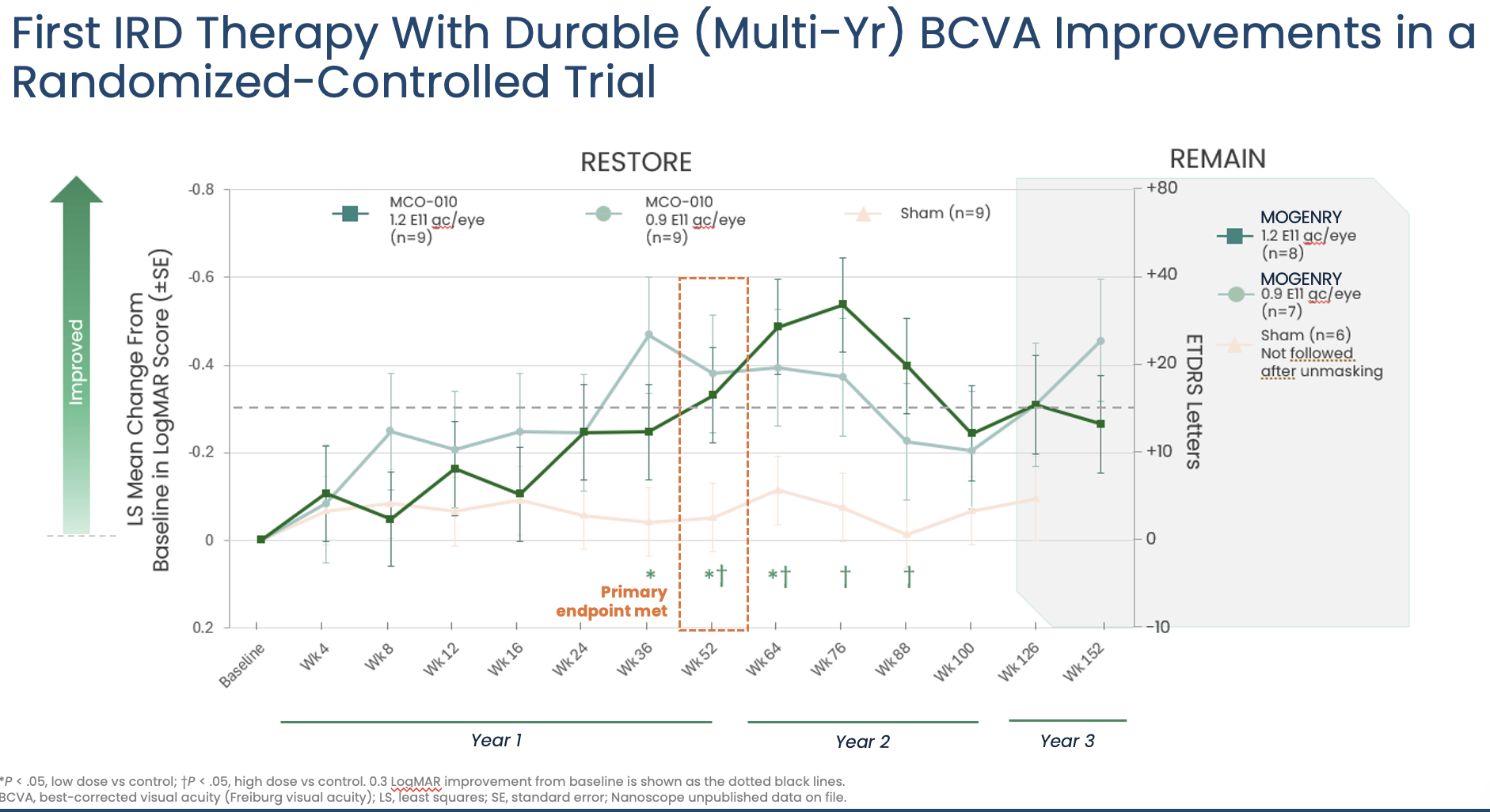
The investigational therapy was also reported to be well tolerated, with no treatment-related serious adverse events.
Most patients treated in RESTORE subsequently continued into the REMAIN study, which is providing long-term follow-up data included in the BLA.
Allen C. Ho, MD, professor of ophthalmology at Thomas Jefferson University, director of retina research at Wills Eye Hospital, and chief medical advisor for Nanoscope Therapeutics, said the therapy’s potential accessibility could be particularly important for patients outside major academic centers.
“Mogenry does not require genetic testing or administration in a surgical suite, which could enable broad adoption by community retina practices,” Dr. Ho said in the company’s announcement.
Mogenry is designed to address vision loss through optogenetics rather than targeting a particular disease-causing mutation. The approach is intended for patients who have experienced photoreceptor loss from retinal degeneration. That distinction could potentially broaden the population eligible for treatment compared with mutation-specific gene therapies because patients would not need to have a particular genetic variant to qualify.
Nanoscope is also positioning the therapy as a one-time, in-office treatment, potentially avoiding the surgical-suite administration required for some ocular gene therapies.

