


Today, the Zeiss Group is commemorating 100 years of operation in the United States. Since establishing its first US branch on New York City’s 5th Avenue in 1925 with just 39 employees, Zeiss has grown into a multi-business technology leader with more than 3,500 employees across 30+ American locations.
Over the past century, Zeiss technologies have helped Americans achieve profound breakthroughs—from scientific discovery and space exploration to precision healthcare and the future of digital innovation. According to Zeiss, the company's technologies have been integral to many pivotal moments in US history, including:
-
Space Exploration: Zeiss optics captured the first images of Earth from the moon and continue to shape planetary science, including development of the Mars rover
-
Filmmaking Excellence: Zeiss lenses have earned multiple technical Academy Awards, empowering filmmakers with new creative possibilities and reshaping visual storytelling
-
Breakthroughs in Scientific Research: Zeiss innovations—from fluorescent microscopy to live-cell 3D imaging—have enabled entirely new methods of studying life at the microscopic level
-
Precision Manufacturing: From Silicon Valley to Detroit, Zeiss metrology and semiconductor technologies support faster, smaller, and more efficient digital devices
-
Quality Assurance: Zeiss measurement solutions ensure precision manufacturing across U.S. industries, helping maintain quality on American assembly lines
-
Advances in Surgical Care: Zeiss introduced the first surgical microscope in 1953 and continues to lead in ophthalmology, neurosurgery, oncology, and medical imaging
-
Enhanced Outdoor Experiences: Zeiss binoculars and rifle scopes help nature lovers and sportspeople see more of the world with exceptional optical clarity
-
Vision Protection for Millions: Zeiss UV protection technology has advanced eye health nationwide
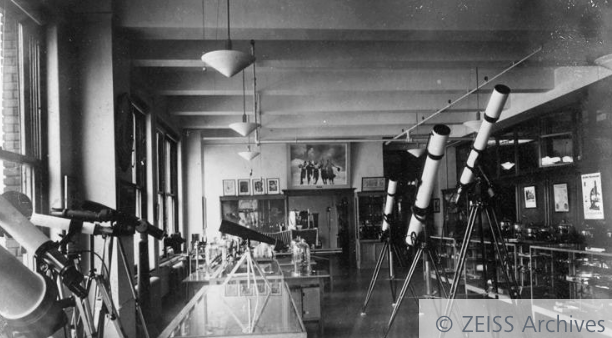
Zeiss opens a distribution office in New York City as Carl Zeiss Inc., later headquarted on Fifth Ave.
“The development of Zeiss in the US is a true success story,” said Andreas Pecher, President and CEO of Zeiss Group. “We are proud to look back on what we have achieved together over the past 100 years—and equally excited for the future. Alongside our American partners, we will continue to drive and shape innovation.”
“On December 11, 1925, Carl Zeiss Inc. filed as a legal entity in New York, marking the beginning of our journey in the United States,” said Moosah Gulam, President of Carl Zeiss, Inc. “As we celebrate this centennial, we honor our rich history and reaffirm our long-term commitment to the U.S. market and our customers.”
Since 1953, Zeiss has played a important role in the evolution of surgical care with the introduction of the first surgical microscope. Today’s Zeiss surgical platforms integrate robotics, digital imaging, and advanced ergonomics to improve both patient outcomes and surgeon experience. According to Zeiss, in the 1990s, Zeiss brought to the U.S.:
-
The gold-standard automated visual field analyzer
-
The first commercial OCT device, transforming detection of retinal disease
-
The IOLMaster, pioneering precision biometry for cataract surgery
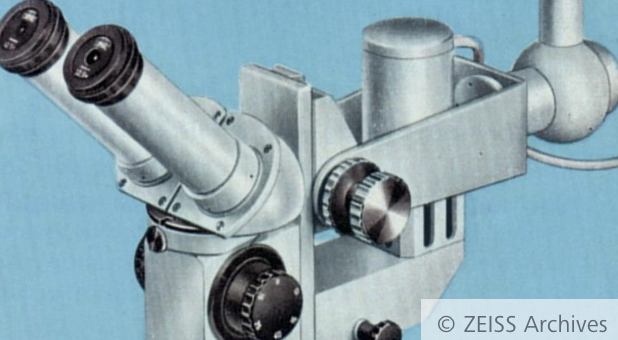
ZEISS OPMI 1 debuts as the world's first surgical microscope, leading to its widespread adoption in operating rooms, enabling microsurgery globally.
Other technologies include:
-
SMILE — introduced in the U.S. in 2016 — became the first minimally invasive laser vision correction procedure, offering rapid recovery and excellent visual outcomes.
-
In 2025, Zeiss introduced the INTRABEAM 700 platform to the U.S., enabling robotic-assisted intraoperative radiotherapy and enhancing collaboration between neurosurgeons and oncologists in the fight against brain tumors.
For more information about Zeiss’s centennial and a detailed historical timeline of the company’s impact in America, click here.
