


Key Takeaways
- At 6 months, third-generation Z+ IOL eyes achieved mean uncorrected visual acuity of 20/24 at distance and 20/26 at near under photopic conditions
- No serious adverse events or halos were reported; 79% of patients reported no glare
- The virtual-aperture design is intended to extend depth of focus without splitting light among multiple focal points, and additional clinical evaluation is underway in Europe
Z Optics reported 6-month clinical data for its investigational Z+ Virtual Aperture IOL, with results showing a range of uncorrected vision from distance to near and no serious adverse events in a single-center study.
The findings were presented at the 44th Congress of the European Society of Cataract and Refractive Surgeons (ESCRS), held September 11-15, 2026, in London. Francisco Sánchez León, MD, of Novavision Laser Center in Naucalpan, Mexico, presented the study, “Safety and Effectiveness of a Total Depth-of-Focus Intraocular Lens with a Virtual Aperture Optic.”
The study included 43 patients, representing 86 eyes, who underwent bilateral implantation with the Z+ IOL. Of those, 38 eyes received the latest third-generation design.
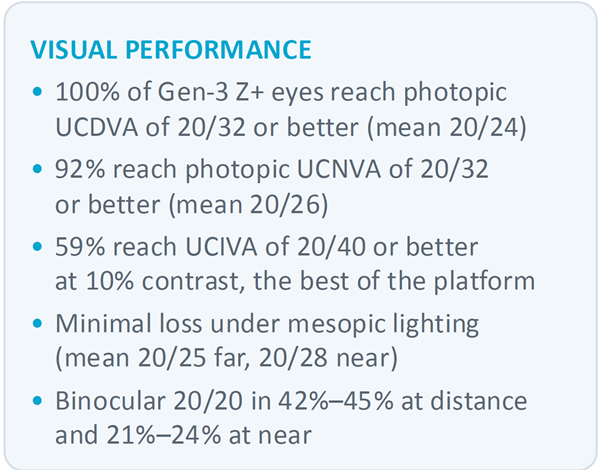
At 6 months, all eyes implanted with the third-generation lens achieved uncorrected distance visual acuity of 20/32 or better under photopic conditions, with a mean acuity of 20/24. Uncorrected near visual acuity of 20/32 or better was achieved by 92% of eyes, with a mean of 20/26, according to a company news release.
Visual acuity was largely maintained under mesopic conditions, according to the company. Mean uncorrected visual acuity was 20/25 at distance and 20/28 at near. All eyes achieved best-corrected distance visual acuity of 20/25 or better. At intermediate distance, 79% of eyes achieved 20/40 or better on a 10% low-contrast chart. Binocular uncorrected visual acuity averaged 20/23 at distance and 20/25 at near.
“What impressed us in this series is how consistent the results are,” Dr. Sánchez León said in a statement. “Patients see well at distance, intermediate and near, and they keep that vision when the light goes down.”
No serious adverse events were reported through the 6-month follow-up period. According to the company, no patients reported halos. Glare was absent in 79% of patients, while 18% reported mild glare and 3% reported moderate glare. Mean corneal endothelial cell density was 2,475 cells/mm² at 6 months.
The Z+ IOL uses a 2.8-mm central optic surrounded by what the company describes as a geometric virtual aperture zone. Rather than dividing incoming light among multiple focal points, as occurs with multifocal optics, the design is intended to redirect out-of-focus light away from the central retina.
Z Optics said the approach is designed to provide an extended range of vision while preserving contrast and minimizing dysphotopsias associated with light-splitting lens designs. Dr. Sánchez León characterized the clinical objective during the ESCRS presentation as providing “multifocal visual acuity with monofocal clarity.”
The Z+ Virtual Aperture IOL is also undergoing evaluation in a multicenter European clinical study with sites in Switzerland, Spain, and Portugal. The company said results will be reported following completion of data collection and analysis.
The ESCRS presentation was co-authored by Jaime Martiz, MD, and Rocio Sánchez Sanoja, MD, of Novavision Laser Center; Edwin Sarver, PhD, chief technology officer at Z Optics; and Matthew Schuster, vice president of engineering at Z Optics.
