


Key Takeaways
- VOYAGER real-world data showed visual and anatomical improvements with Vabysmo in treatment-naive eyes across wet AMD, DME, and RVO, while previously treated eyes generally maintained or improved vision alongside anatomical improvements
- Reductions in subretinal and intraretinal fluid were observed across the study cohorts in both previously untreated and previously treated eyes
- Patients with wet AMD and DME received fewer Vabysmo injections during months 7 through 12 than during months 1 through 6, suggesting extension of treatment intervals
New real-world data from the VOYAGER study showed visual and anatomical improvements with Vabysmo (faricimab-svoa) across wet age-related macular degeneration (AMD), diabetic macular edema (DME), and macular edema following retinal vein occlusion (RVO), according to Roche/Genentech.
The findings, presented at the EURETINA 2026 Annual Meeting in Vienna, Austria, included outcomes among both treatment-naive and previously treated patients. The comapnies said the results were consistent with findings from the phase 3 clinical trial program for Vabysmo.
The VOYAGER findings also provide real-world information about treatment patterns. In the wet AMD and DME cohorts, patients received fewer Vabysmo injections during months 7 through 12 than during months 1 through 6.
Genentech said the reduction suggests that treatment intervals were extended during the second half of the first treatment year.
The company reported that Vabysmo's safety profile in VOYAGER was generally consistent with the established safety profile observed in phase 3 studies involving wet AMD, DME, and RVO.
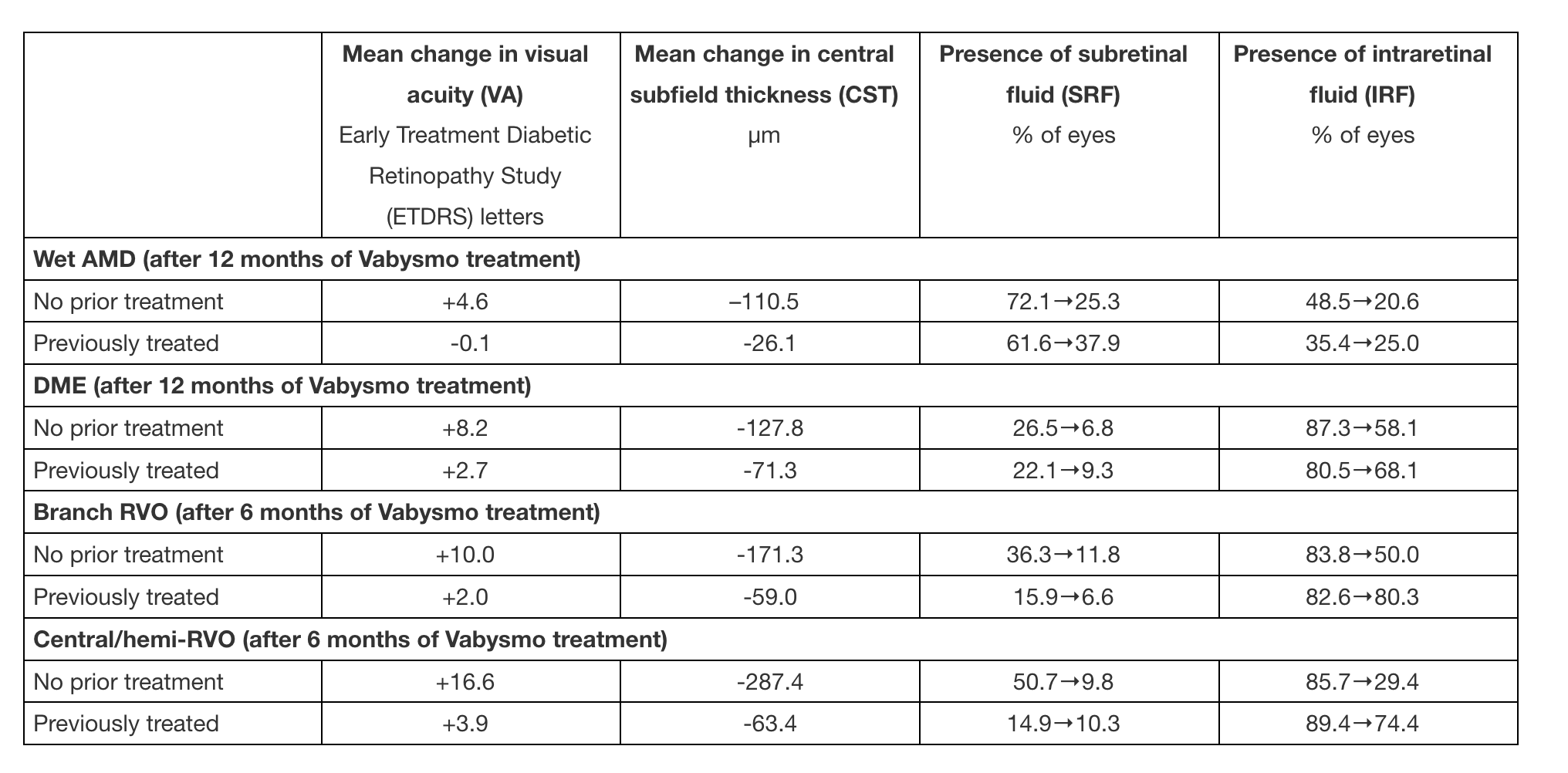
In the wet AMD and DME cohorts, previously untreated eyes experienced improvements in vision and central subfield thickness (CST) after 12 months of Vabysmo treatment. Previously treated eyes maintained stable vision while demonstrating improvements in CST.
“These real-world results underscore how the efficacy and safety observed in our pivotal Vabysmo studies translate directly into routine clinical practice globally,” Levi Garraway, MD, PhD, chief medical officer and head of Global Product Development, said in a statement. “The sustained visual improvements and meaningful anatomical drying seen in the VOYAGER study reinforce the role of Vabysmo in helping to address important unmet needs for patients with retinal conditions.”
The study also evaluated Vabysmo in patients with branch RVO and central/hemi-RVO. After 6 months of treatment, previously untreated and previously treated eyes in the central/hemi-RVO cohort demonstrated improvements in both vision and CST. In the branch RVO cohort, previously untreated eyes experienced improvements in vision and CST at 6 months. Previously treated eyes maintained stable vision while demonstrating improved CST, according to Genentech.
Across the wet AMD, DME, and RVO cohorts, investigators also observed reductions in the presence of subretinal fluid (SRF) or intraretinal fluid (IRF) among both previously untreated and treated eyes.
The VOYAGER findings also provide real-world information about treatment patterns. In the wet AMD and DME cohorts, patients received fewer Vabysmo injections during months 7 through 12 than during months 1 through 6.
Genentech said the reduction suggests that treatment intervals were extended during the second half of the first treatment year.
The company reported that Vabysmo's safety profile in VOYAGER was generally consistent with the established safety profile observed in phase 3 studies involving wet AMD, DME, and RVO.
