


Notal Vision reported that results of the first U.S.-based feasibility study with its investigational home-based optical coherence tomography (OCT) platform were presented at the Retina Society and the American Society of Retina Specialists (ASRS) annual meetings. The Notal Home OCT pipeline technology is designed to provide patient-initiated retinal OCT scans to support the management of patients with wet age-related macular degeneration (AMD), complementing existing standard of care treatments as well as emerging longer acting drugs and drug delivery systems.
The study evaluated the ability of subjects with wet AMD to perform sequential daily self-imaging of their eyes for 3 months with the user-friendly, self-operated, tele-connected Notal Home OCT device following self-setup in their homes. Images from the device were securely and automatically transmitted via a built-in cellular modem to the Notal Health Cloud and remotely reviewed by study investigators via the secure web viewer. OCT images were then processed for identification and quantification of retinal fluid, a key biomarker in wet AMD, by the proprietary Notal OCT Analyzer (NOA) deep learning algorithm.
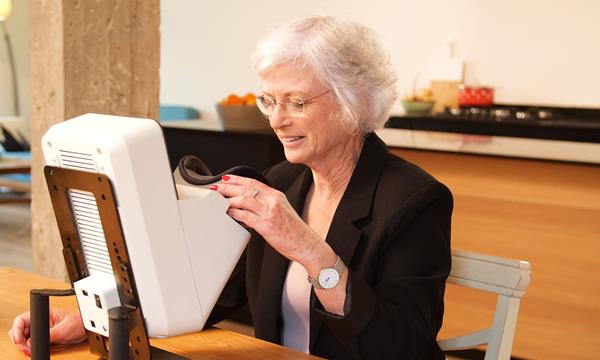
The feasibility study showed the device’s ease of use, good image quality, compliant self-imaging and spatio-temporal tracking of retinal fluid in an elderly wet AMD patient population, according to a company news release. These results confirm findings from the longitudinal pilot study reported by Keenan et al. in Ophthalmology Science earlier this year.
“Patients ability to self-image and generate high quality OCT scans at home for remote physician review was impressively demonstrated in this wet AMD population," Jeffrey S. Heier, MD, one of the study’s principal investigators and director of the retinal service and retinal research at Ophthalmic Consultants of Boston, said in a company news release. “Insights in disease dynamics and treatment response gained from AI-based analysis of up to daily home OCT images provide opportunities for personalized treatment and accelerated development of new drugs.”
“Home OCT patient monitoring has great potential to help reduce treatment burden on patients and caregivers supporting long-term adherence to therapy and improved outcomes,” said Nancy Holekamp, MD, co-principle investigator of the study and director of retina services at Pepose Vision Institute. “The remote monitoring services that patients receive from digital health providers allow retina specialists to extend their care to the patient’s home.”
“The results of the first U.S. study confirm the key target product profile requirements of our Home OCT program,” said Kester Nahen, PhD, CEO of Notal Vision. “We would like to thank Genentech, a member of the Roche group, for their financial support of the study and are excited to progress on our path toward FDA clearance of the system.”
Study Design & Results
A cohort of 15 subjects with an average age of 70.4 years and a visual acuity ranging from 20/20 to 20/200 self-imaged at home for 90 days, producing 2,374 OCT scans. Of the overall imaging attempts, 96% were successfully completed in a median time of 40 seconds with 97% of images meeting the predefined criteria of good quality. Subjects used the device an average of 5.7 days per week, and a median of 1.0 scan reminders were provided by the patient engagement and compliance monitoring service of the Notal Vision Monitoring Center, future medical provider of the Notal Home OCT program,. Patients gave positive feedback about their experience on an exit questionnaire, especially regarding the device’s ease of use and interaction with the Monitoring Center.
Scan quality criteria was met in 93% of scans for the artificial intelligence-based NOA algorithm to perform fluid quantification. In 83% of the images, investigators and NOA agreed on the absence or presence of fluid. Where there was disagreement, the investigators identified only subtle, trace, or no fluid. The spatial and temporal distribution of intra- and subretinal fluid was tracked through fluid thickness maps and volume trajectories.
Novel fluid volume trajectories gave deep insights in the heterogeneity of disease dynamics and treatment response. In some cases, pre-scheduled treat-and extend office visits exposed the retina to reoccurring or persistent fluid over an extended period of time. These findings confirmed the need for an alert mechanism based on physician defined eye-specific fluid volume thresholds, which is currently under development. Moreover, the parametric description of fluid volume trajectories may support disease and treatment response classification.
Notal Vision’s home-based OCT pipeline technology received FDA Breakthrough Device designation at the end of 2018 and is in the process of obtaining FDA clearance. In January 2020 the American Medical Association established three category III Current Procedural Terminology (CPT) codes for reporting patient-initiated remote retinal OCT scans, facilitated by Notal Vision’s home-based OCT. The physician review, interpretation and documentation of AI-based analyses will be billable every 30 days.
