


Recent research suggests that the way people sleep may significantly impact eye pressure. A study published ahead of print in the British Journal of Ophthalmology has found that resting with a high-pillow head position—defined as elevating the head by 20–35° using two pillows—is associated with significantly higher IOP and lower ocular perfusion pressure (OPP) in people with glaucoma compared with lying flat on the back.1
Scientists enrolled 144 glaucoma patients and measured their IOP in two different positions: the standard lying-flat (supine) posture and a head-elevated position supported by extra pillows. They also examined jugular venous changes in 20 healthy volunteers using ultrasound to understand possible mechanisms behind any pressure differences.
Key Findings
-
Patients in the high-pillow position showed higher IOP, greater 24-hour IOP fluctuation, and decreased OPP compared with the supine posture (all P<0.001).
-
These changes were more pronounced in younger patients and those with primary open-angle glaucoma (POAG) compared to normal-tension glaucoma.
-
Greater postural IOP change was linked to thicker central corneal thickness and POAG diagnosis.
-
In healthy volunteers, ultrasound revealed that the high-pillow posture compressed the jugular veins and increased internal jugular vein blood flow velocity, a possible explanation for increased eye pressure.
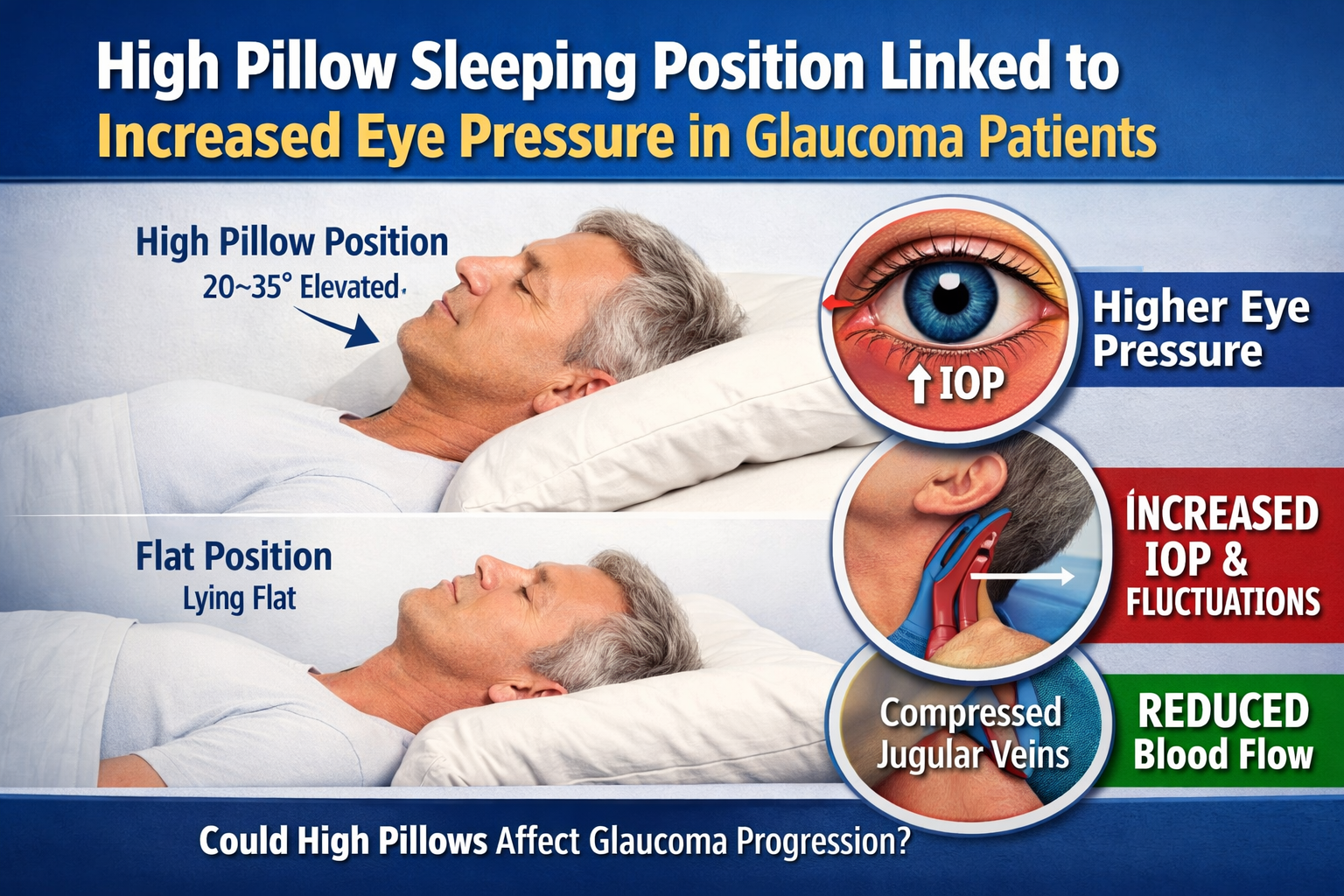
Although prior research has explored posture and IOP, this study is among the first to evaluate sleep posture as a modifiable factor in a clinical setting. The findings suggest that sleeping with excess head elevation could exacerbate pressure fluctuations in glaucoma patients, potentially influencing disease progression. Avoiding sleeping positions that compress neck veins—such as using excessively high pillows—may help mitigate overnight IOP increases, though the authors stress that further research is needed to confirm these results and test long-term outcomes.
The authors recommend larger and longer longitudinal studies to determine whether altering sleep posture can slow glaucoma progression or reduce vision loss risk. They also highlight the importance of considering individualized patient counselling on sleep habits as part of comprehensive glaucoma care.
Reference
1. Liu T, Hu M, Liu X, Wang Z, Yao K, Chen M, Wang K. Association of high-pillow sleeping posture with intraocular pressure in patients with glaucoma. Br J Ophthalmol. 2026 Jan 27:bjo-2025-328037. doi: 10.1136/bjo-2025-328037. Epub ahead of print. PMID: 41592946.
