


Key Takeaways
- Eyestem reported interim phase 2 findings for Eyecyte-RPE, an investigational RPE cell therapy for GA secondary to dry AMD, with 24 participants enrolled in the randomized controlled study
- Early treated participants have demonstrated visual acuity improvements, including an average 16-letter gain among 3 phase 2 participants reaching 6 months
- Eyestem said Eyecyte-RPE has maintained a favorable safety profile to date and plans to file a US IND application in early 2027
Eyestem Research has reported interim findings from a randomized phase 2 clinical trial evaluating Eyecyte-RPE, its investigational retinal pigment epithelial (RPE) cell therapy for geographic atrophy (GA) secondary to dry age-related macular degeneration (AMD).
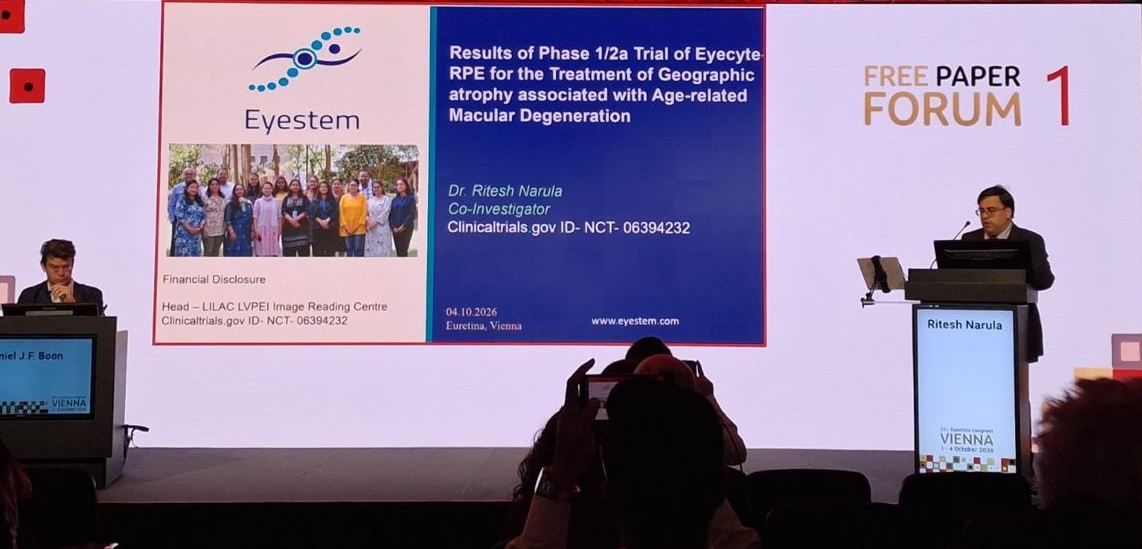
The findings were presented by Ritesh Narula, MD, co-principal investigator of the trial, at Euretina 2026 in Vienna, Austria. According to the company, the phase 2 program is progressing as it prepares to submit a US investigational new drug application in early 2027 for the treatment of GA and associated vision loss.
The randomized, controlled phase 2 trial has enrolled 24 participants, including 15 in the treatment arm and 9 in a natural history control arm.
Eyestem reported that Eyecyte-RPE has demonstrated a favorable overall safety profile in the phase 2 study to date, consistent with findings from the preceding phase 1 trial. Seven surgeons have performed the procedures using the company's investigational surgical technique.
The company also reported longer-term follow-up of participants from the phase 1 study. Among 7 participants with 12 months of follow-up, visual acuity improved by an average of 13 letters from baseline. Four participants who reached 18 months of follow-up maintained an average improvement of 15.3 letters from baseline.
Early phase 2 findings were described as consistent with the phase 1 observations. Three participants who completed 6 months of follow-up in phase 2 demonstrated an average 16-letter improvement from baseline, according to Eyestem.
Across both phases, 12 participants had completed 6 months of follow-up, with an average improvement of 13.8 letters from baseline.
The interim findings are based on small numbers of participants, and the company did not provide comparative efficacy results for the phase 2 natural history control group in its announcement. Additional follow-up and controlled data will therefore be needed to characterize the treatment's potential efficacy.
“Early results from the phase 2 clinical study build on the highly promising phase 1 results, achieving an important milestone for Eyestem’s geographic atrophy program,” Jogin Desai, founder and CEO of Eyestem, said in a statement. “We are encouraged to see the gains sustained over longer follow-up periods coupled with a good safety profile. Together, these findings give us greater confidence in the potential of Eyecyte-RPE to meaningfully change the treatment landscape for patients with geographic atrophy across the world.”
Eyecyte-RPE is an investigational allogeneic RPE cell therapy derived from human induced pluripotent stem cells. The treatment is designed to replace RPE cells that have been damaged or lost as GA progresses, with the aim of potentially supporting tissue regeneration in the diseased retina.
