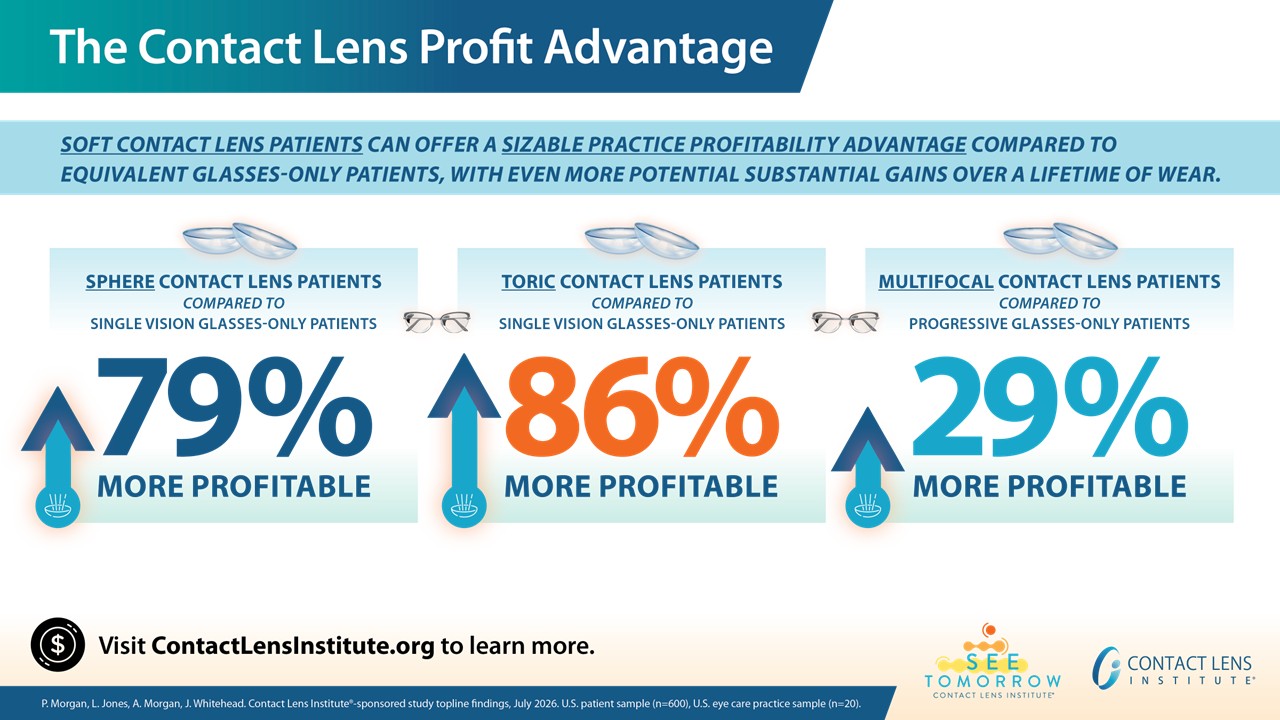
A new analysis commissioned by the Contact Lens Institute (CLI) suggests that patients who wear soft contact lenses generate substantially higher annual profits for US eye care practices than comparable patients who wear glasses alone, with profitability advantages ranging from 29% to 86% depending on lens type.
The research, conducted by a team of ophthalmic and economics investigators, analyzed 4 years of anonymized patient and operational data from 20 US eye care practices. According to the findings, average annual customer-level profits were $436 for spherical soft contact lens wearers, $453 for toric lens wearers, and $485 for multifocal contact lens wearers. By comparison, annual profits averaged $244 for single-vision glasses patients and $376 for progressive glasses patients.
The study incorporated anonymized records from 30 patients per participating practice, along with operational metrics including professional fees, chair time, staff compensation, and secondary revenue streams. Based on these data, the investigators concluded that soft contact lens patients provide a meaningful profitability advantage over equivalent glasses-only patients, with potential financial benefits increasing over a patient's lifetime of lens wear.
The analysis was led by Professor Philip Morgan of the University of Manchester, Professor Lyndon Jones of the Centre for Ocular Research & Education (CORE) at the University of Waterloo, and Professors Ash Morgan and John Whitehead of the Department of Economics at Appalachian State University. CLI commissioned the research as part of its multiyear "See Tomorrow" initiative.
"It’s clear that contact lens customers can generate greater average annual profit, even with higher service and product costs," Prof. Morgan said in a statement. "Our findings suggest that recurring purchases, greater examination frequency, and opportunities for ancillary spending may make contact lens wearers particularly attractive from a customer lifetime value perspective."
According to CLI, the analysis represents the first published evaluation of contact lens profitability in the United States. The organization noted that the study follows the London Business School's "Seeing Things Clearly" report, published 25 years ago, which examined the economics of contact lens practice across five European markets.
"The new data squarely challenges profitability myths that can creep into conversation despite a lack of evidence," said CLI Executive Director Stan Rogaski. "For instance, prior CLI See Tomorrow work showed that more than half of eye care practices don't even attempt to quantify the business impact of their contact lens patients. Among those who do, they significantly underestimate the relative profitability compared to glasses-only patients."
CLI said the complete analysis will be published later this year as part of a comprehensive See Tomorrow report.